
Basic blind installation is manageable as a DIY project for most people. A standard bracket-mount horizontal blind on a simple frame window takes 20-30 minutes per window with a drill, a level, and a pencil.
Custom-fit blinds, large windows, heavy products, and anything with a complex frame get harder. And the most common place things go wrong isn't the drilling; it's measuring the window and choosing the right mount type before you ever pick up a tool.
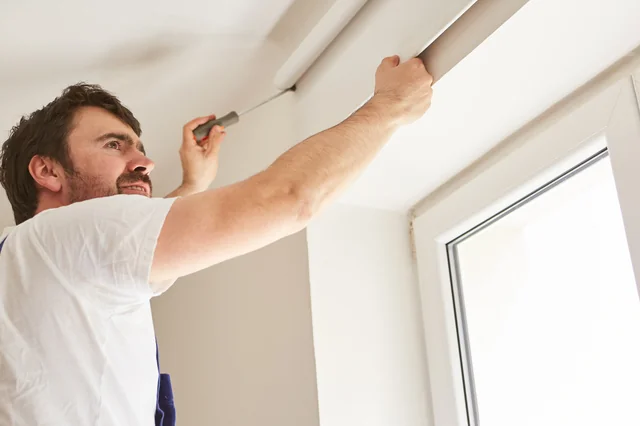
What DIY Blind Installation Actually Involves
A standard inside mount installation: mark bracket positions with a pencil, confirm they're level, drill pilot holes, screw in the brackets, snap the blind headrail in, attach the valance if there is one. Two brackets for most windows under 48 inches, three for wider spans.
Outside mount adds one step: deciding how far above and beyond the window opening to position the brackets, which affects how much wall space you cover and how much light you block at the edges.
The tools you need are not specialized: a drill, a level, a pencil, a tape measure, and the right screw size for your wall type. The bracket hardware comes with most blind packages.
Where DIY Installation Usually Goes Wrong
Brackets not level is the most common mistake. A blind that's off by a quarter-inch on one side looks noticeably crooked once it's hung. You see the gap on one side and the slats don't sit flat when closed.
Wrong screw type for the wall or frame is the second. Drywall without a stud behind it won't hold bracket screws under repeated operation stress. Hitting a stud or using the right wall anchor matters.
Mount type chosen wrong is the third. Choosing an inside mount when the frame doesn't have enough depth leaves the blind protruding from the window or unable to operate fully. This is the mistake that's hardest to fix after the fact.
Our inside vs. outside mounts guide covers how to determine which mount type works for your specific window before any holes get drilled.
When Professional Installation Is Worth the Cost
Heavy blinds and large windows are the first category. A wide faux wood blind or a large roller shade is heavy. Getting the brackets positioned and the headrail seated correctly while keeping everything level requires two people or significant experience. Getting it wrong means the blind is crooked, the brackets are off-center, or the headrail doesn't seat right.
Bay windows, arched windows, and any non-standard frame add complexity. Bracket placement in a bay window corner requires planning. An arched window needs a different mounting approach entirely. These aren't standard DIY territory.
Multiple windows is also worth considering. Installing one window is a project. Installing twelve windows in a day is either a very long day of DIY or a few hours of professional work. The break-even point where professional installation saves time and stress comes earlier than most people expect.
Our professional installation guide explains what a correct installation involves and what to check when it's done.
What Custom-Fit Blinds Need That Off-the-Shelf Products Don't
Custom-fit blinds are made to the exact dimensions of your window. If the measurement going into the order is wrong, the product arrives wrong. There's no adjustment available once it's manufactured.
This is why custom blind orders begin with in-home measurement, not self-measurement. A professional who measures several windows a day knows what to account for: frame irregularities, trim profiles that reduce usable depth, and mounting surfaces that aren't where they're supposed to be.
DIY measurement for a custom order works for straightforward windows. For anything with an irregular frame, non-standard depth, or unusual trim, professional measurement before ordering is the step that prevents the wrong product from showing up.
Our precision measurement guide explains exactly what measurements matter and what can go wrong when they're off.
How Creative Blinds and Drapes Handles Installation in Aurora, IL
Creative Blinds and Drapes measures, supplies, and installs window blinds and shades in Aurora, IL with our own team. We don't leave you with a product and an instruction sheet. We schedule installation, come to your home, mount everything correctly, test every product, and clean up before leaving.
Our blind installer team handles all product types across Aurora, IL and surrounding communities.
See our service coverage on the service areas page or contact us to book your free in-home consultation.